
Juneteenth…It’s Personal!
Written by Carey Mason, DEI4BIZ
 On June 19, 2026, our great nation will celebrate the 161st anniversary of “Juneteenth” which has been a recognized federal holiday since 2021. First celebrated as “Jubilee Day”, Juneteenth has become very personal for my family since we discovered a direct connection to the events that preceded the creation of this federal holiday.
On June 19, 1865, Union Army Major General Gordon Granger traveled to Galveston, Texas and issued General Order No. 3 notifying “the people of Texas that all enslaved people were now free”. Texas was the last state to end slavery even though the Emancipation Proclamation officially ended slavery on January 1, 1863.
It took the Union Army more than 2 years to enforce the Emancipation Proclamation in Texas. Per Wikipedia, “the Emancipation Proclamation changed the relationship between the formerly enslaved and their former masters to that of employer and hired laborer.” Many formerly enslaved people became sharecroppers receiving a portion of the crops they sowed and harvested in exchange for providing cheap labor to the plantation owners and farmers. No longer enslaved, they became indebted to the land they farmed.
Before issuing the Emancipation Proclamation, President Abraham Lincoln offered freedom to any slave who escaped from bondage and enlisted in the Union Army. 186,000 Black soldiers served in the Union Army during the Civil War. One of those soldiers, Moses Adair, was my great-great-grandfather. Moses Adair was the illegitimate son of Lafayette Adair, an architect who owned a plantation in Breckenridge, Ky. According to an 1860 slave record, my great-great-grandfather had “a brown complexion and was 17 years of age”. Moses escaped the Adair plantation accompanied by his wife, Johanna and enlisted in the Union Army on June 20th, 1864. He completed his basic training at Camp Nelson, found 90 miles southwest of Louisville, Ky. At its peak, Camp Nelson housed more than 2,000 residents who produced goods and services for the Union Army. While Moses lived in the barracks, his wife stayed in family housing provided by Camp Nelson.
Moses mustered out of the Union Army in Helena, Ak on March 16, 1866, returning to Kentucky where he lived until his death in 1906 at the age of 68. During the 40 years that Moses lived in Louisville, he worked as a livery driver and practiced various freedoms including the right to sue. A Courier-Journal newspaper article reported that Moses won 2 lawsuits and received monetary judgements from two White plaintiffs. As a Civil War veteran, Moses received a modest pension which his wife, Johanna collected until her death in 1934. Following his death, the obituary printed by the Courier-Journal proclaimed, “he (Moses) was one of the most respected colored persons known at that time”.
I grew up in Louisville, KY during the early 60’s in the heat of the Civil Rights Movement. I had little knowledge of my family history beyond what I learned from my paternal and maternal grandmothers who were born respectively before and after the turn of the century. Like many Black families, our family had few written records documenting our family history. Most of what we know was based upon recollections, memories and stories passed down from generation to generation. Somehow, the existence of Moses Adair and his Civil War history was not shared with me nor my siblings. I suspect my older relatives were unaware of Moses’ existence, much less his role in the Civil War. Beginning in the early 2000’s, my younger sister leveraged online tools to access government records, real estate records, chattel records documenting the buying and selling of property including enslaved people, voter rolls, birth certificates, and death certificates. To date, my sister has documented the existence of more than 484 family members dating back to the early 1800’s. Growing up, only 40 to 50 of those family members were known to my immediate family.
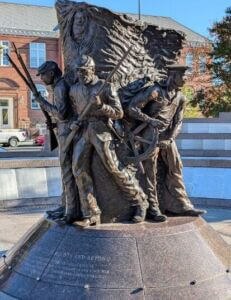
Two years ago, I travelled to Nicholasville, KY and visited Camp Nelson which is now a national park. I hiked the trails walked by my great-great-grandfather in 1864, seeing the same rolling fields he saw during his basic training. The following year, I traveled to Washington, DC and visited the African American Civil War Memorial. The U Street/African American Civil War Memorial/Cardozo metro train station is located across the street from the museum. Just outside the entrance to the metro train station The Spirit of Freedom sculpture honors the African American soldiers who fought in the Civil War. The name of each soldier including my great-great-grandfather is printed on multiple plaques surrounding the sculpture in cascading circles.
Growing up in Louisville during the sixties, I learned about the Civil War and the Emancipation Proclamation in history class. Very little was taught about the role of African Americans soldiers in the Civil War and how their participation hastened the end of the war. I did not know of my great-great-grandfather’s personal history nor his service to our country. I, like many others of my generation, engaged in the war for Civil Rights, equity, and the celebration of diversity. Since learning of Moses Adair’s existence and how he won his freedom, I wonder what might have happened had he not escaped the plantation and joined the Union Army. He might well have remained on the plantation working as a sharecropper instead of relocating to Louisville and beginning a new life in an urban setting. By escaping the plantation and enlisting in the Union Army Moses Adair undertook a huge risk with no guarantee of survival, much less freedom. He willingly risked his life believing he, his current family and the generations to follow would benefit. His life wager remains a pivotal point in our family history that continues to bear dividends.
As I celebrate Juneteenth, I am proud of the courage displayed by my great-great-grandfather in the 1800’s. My generation and the 3 generations that have followed bear witness to an old African Proverb: "If we stand tall, it is because we stand on the shoulders of many ancestors." Happy Juneteenth!