
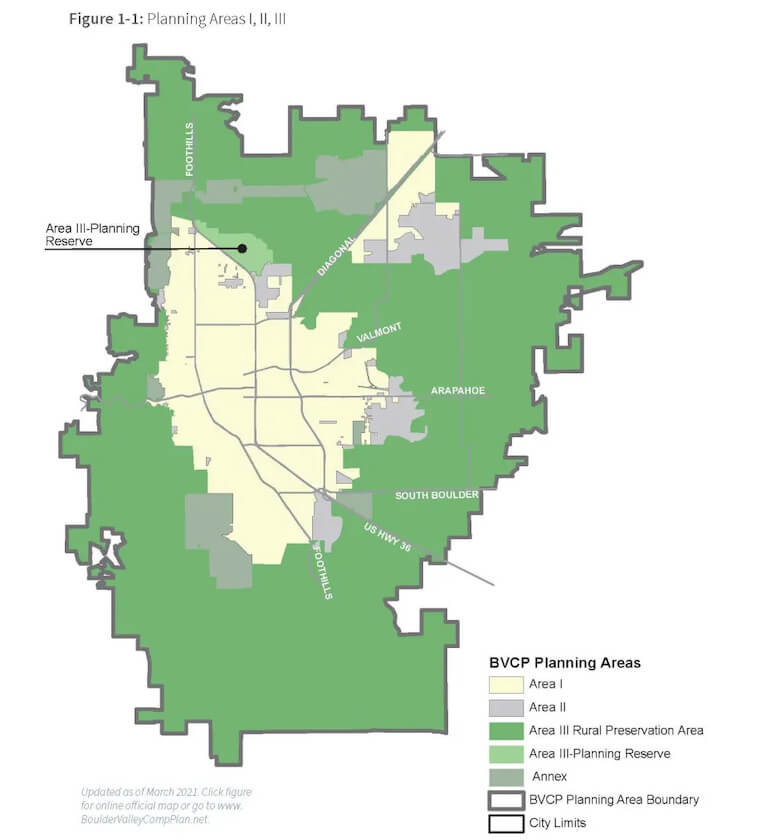
Adopt Motion Finding Sufficient Community Need: Area III Planning Reserve
Boulder Chamber - CO
February 12, 2026
Mayor, Members of City Council,
RE: Adopt Motion Finding Sufficient Community Need – Area III Planning Reserve
On behalf of the Boulder Chamber, we strongly urge City Council to adopt the motion finding that there is sufficient community need to warrant further consideration of a Service Area Expansion Plan for the Area III – Planning Reserve, and to clarify the specific community needs that are of sufficient priority to advance that work.
At this stage, Council is not being asked to approve annexation, urbanization, or infrastructure construction. Rather, you are being asked whether documented and persistent community needs justify further study and structured long-range planning. We believe they do.
There is broad recognition that Boulder lacks sufficient attainable “missing middle” housing — including townhomes, cottage courts, duplexes, and ownership-oriented homes affordable to middle-income households. Over the past two decades, most new housing production has been concentrated in rental multifamily development, including significant student housing, while more than 75% of the city’s residential land remains zoned exclusively for single-family use. Despite incremental reforms, housing costs have continued to rise and attainability for middle-income families has continued to decline.
The question before Council is therefore not whether a need exists, but whether that need can reasonably be fulfilled within the current Service Area (Area I).
Based on market performance, zoning constraints, discretionary review processes, and the practical realities of neighborhood opposition, it is difficult to conclude that sufficient missing middle housing can be delivered at the required scale within Area I alone. Projects of even modest size routinely encounter years of review, downzoning, or denial. While zoning codes can be amended, the unpredictability and risk embedded in the current entitlement process significantly limit production outcomes.
In contrast, the Planning Reserve offers a long-term opportunity to:
- Establish zoning and development standards intentionally designed to achieve missing middle and ownership-oriented outcomes
- Pilot targeted Title 9 reforms in a focused geography before citywide application
- Plan comprehensively for infrastructure, mobility, sustainability, and fiscal impacts from the outset
- Reduce reliance on parcel-by-parcel discretionary battles that have historically constrained supply
Service Area Expansion study, therefore, would meet a community need that is not otherwise achievable within existing conditions.
We recognize that Planning Board recently declined to find sufficient priority “at this time.” We also note that members articulated a potential pathway forward should City Council provide clearer direction and defined objectives. In that spirit, City Council may wish to identify specific community needs that justify further consideration, including:
- The need for attainable missing middle housing, particularly ownership-oriented homes for middle-income households
- The opportunity to create a mixed-use, walkable 15-minute neighborhood model incorporating best practices in sustainability, water use, and climate-responsive design
- The ability to right-size neighborhood-serving parks and public amenities consistent with adjacent context
- The value of treating the Planning Reserve as a pilot project to test zoning and implementation strategies that are difficult to deploy within established neighborhoods
Importantly, adopting the motion preserves optionality. It does not commit the city to urbanization. It authorizes deeper analysis and structured planning so that future decisions can be grounded in data, fiscal modeling, infrastructure sequencing, and clearly defined housing outcomes.
If City Council declines to find sufficient community need at this time, the practical result is that this option is effectively foreclosed for many years — despite ongoing evidence that current policy tools have not delivered the range and quantity of unmet housing the community continues to recognize.
For these reasons, the Boulder Chamber urges you to adopt the motion finding sufficient community need and to articulate the specific priorities that warrant preparation of a Service Area Expansion Plan. We stand ready to support continued analysis, business community engagement, and collaborative policy development as this work progresses.
Thank you for your leadership and thoughtful consideration of this important long-term decision.
Sincerely,
John Tayer
President & CEO
Boulder Chamber